The GLP-1 Revolution Has a Hidden Cost
If you’ve been paying attention to health and fitness conversations in 2026, you’ve heard the buzz: GLP-1 drugs like Ozempic, Mounjaro, and Zepbound are transforming weight loss outcomes. Millions of people are using semaglutide, tirzepatide, and other glucagon-like peptide-1 agonists to shed significant weight faster and with more consistency than traditional diet-and-exercise approaches alone.
The results look remarkable on a bathroom scale. Down 20 pounds. Down 40. Down 60 in less than a year.
But here’s what your scale isn’t telling you: the quality of that weight loss matters as much as the quantity.
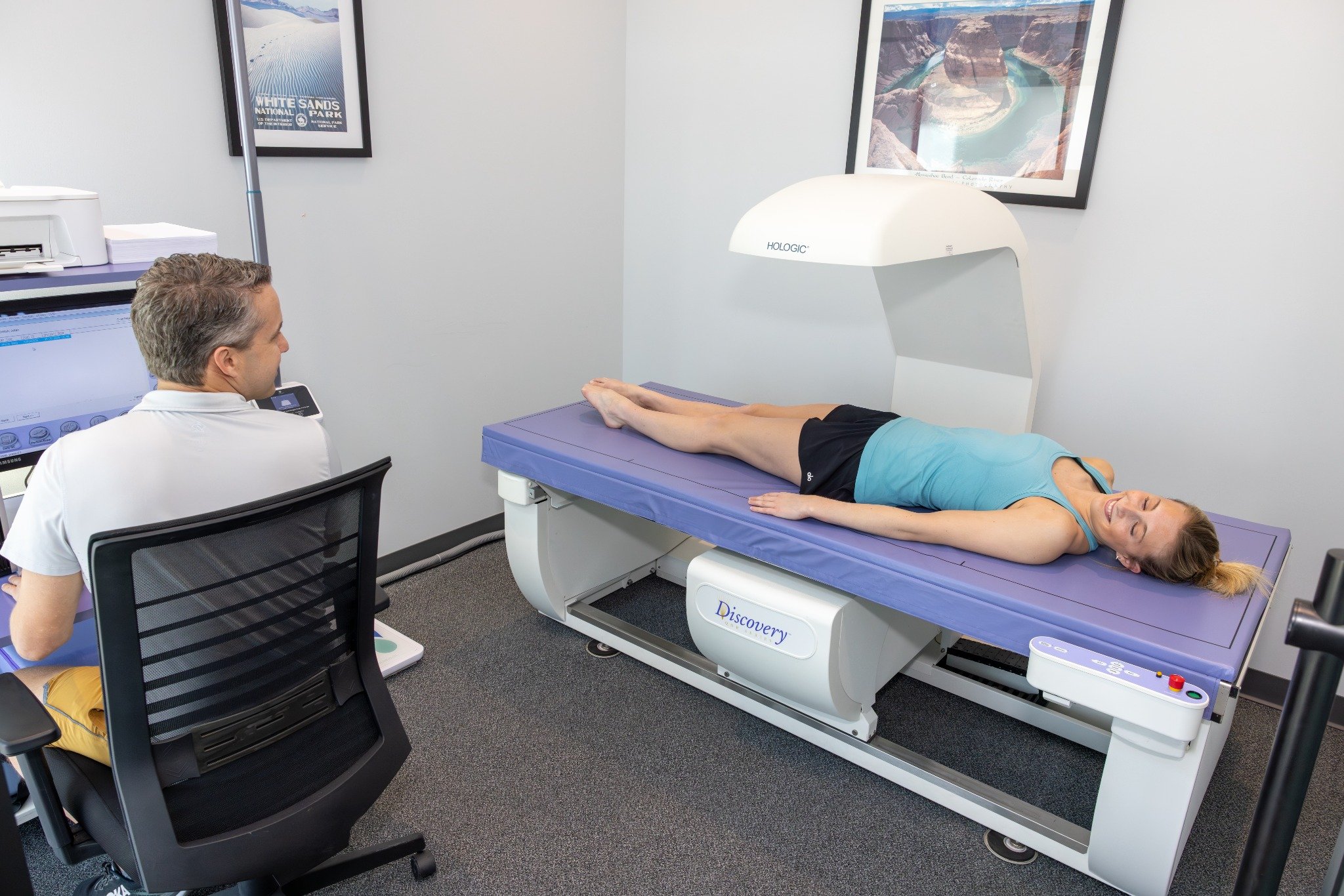
If you’re losing fat while preserving muscle, you’re aging backward. If you’re losing muscle along with fat, you’re aging forward—regardless of what the scale says. This is not your typical gym! This is the difference between a data-driven approach and a guessing game. And DEXA scanning reveals it with certainty.
The GLP-1 Muscle Loss Problem (And Why Nobody Talks About It)
Peter Attia has been sounding the alarm on this for months. Research data is now validating his concerns: GLP-1 users lose muscle at an accelerated rate alongside fat loss, especially without deliberate strength training and adequate protein intake.
Here’s the mechanism: GLP-1 drugs work by suppressing appetite. You eat less. Your caloric deficit grows. Your body burns energy faster than before. This is fantastic for weight loss, but it’s a problem for muscle retention.
When you’re in a caloric deficit and you’re not triggering muscle protein synthesis through strength training, your body preferentially burns muscle for energy. It’s metabolically efficient—and it’s aging you.
The published data backs this up:
- One 2025 study found that GLP-1 users who didn’t strength train lost 30–40% muscle alongside their fat loss.
- The same study showed that GLP-1 users who did strength train and consumed adequate protein (0.8–1.0g per pound of body weight) preserved 85–90% of their lean mass while losing fat.
The difference? Deliberate intervention. Data. Accountability through measurement.
This is where DEXA scanning transforms the conversation.
Why Your Scale (And Even Your Mirror) Lies to You
You step on the scale. You’re down 25 pounds. You feel lighter. Your clothes fit better. The scale feels like proof of success.
But the scale measures everything. Fat. Muscle. Bone. Water. Organs. It can’t tell you what you actually lost.
This is not a minor distinction. Consider two 45-year-old women, both starting at 185 pounds, both ending at 160 pounds after 12 weeks on GLP-1 + no exercise:
Woman A (no DEXA data): Lost 25 pounds total. Celebration? You’d think so. Reality? Lost 18 pounds of fat and 7 pounds of muscle. Age-adjusted VO2 max decline: 8%. Healthspan impact: Moving backward.
Woman B (DEXA-tracked, trained, monitored): Lost 25 pounds total. Same scale outcome. Reality? Lost 24 pounds of fat and maintained lean mass. Age-adjusted VO2 max stability: Maintained. Healthspan impact: Moving forward.
The scale told them the same story. DEXA told two completely different stories.
The DEXA Approach: Your GLP-1 Protection Protocol
If you’re on or considering GLP-1 therapy, here’s how data-driven tracking changes the game:
Baseline DEXA (Week 0): Get a complete body composition scan before starting GLP-1. This gives you lean mass total and regional breakdown, fat mass distribution (visceral vs. subcutaneous), bone density baseline, and your true “starting point”—not a weight, but a composition.
Strength Training Protocol (Weeks 1-12): This isn’t optional if you want to preserve muscle on GLP-1. Research is clear: resistance training 3–4 times per week, targeting all major muscle groups, is the primary driver of muscle retention. Strength training triggers muscle protein synthesis. It sends a signal to your body: this muscle is being used. Don’t burn it for energy.
Protein Intake (Critical): On a caloric deficit from GLP-1, you need more protein per pound of body weight, not less. Aim for 0.8–1.0g per pound of target body weight daily.
Mid-Point DEXA (Week 6): Six weeks into GLP-1 + training protocol, get a re-scan. This mid-point check reveals whether muscle is being preserved or lost, whether you’re responding to the training stimulus, and whether you need to adjust protein, training frequency, or intensity.
Final DEXA (Week 12): Your end-point scan tells the full story. Exactly how much fat you lost. Exactly how much lean mass you retained. Regional changes. Updated bone density and visceral fat metrics.
The Plus10 Advantage: Data-Driven GLP-1 Monitoring
Here’s what makes this approach real: Plus10 specializes in exactly this kind of personalized, data-driven monitoring.
When you work with us on GLP-1 body composition tracking, you get:
DEXA Scans (Baseline + 6-week + 12-week): Three scans over three months give you unambiguous insight into your composition changes. No guessing. No assumptions. Just data.
RMR Testing (Metabolic Baseline): Your resting metabolic rate changes when you lose weight and muscle. A mid-protocol RMR retest shows whether your metabolism is adapting as expected or declining too steeply.
Lactate Threshold Testing (Performance Check): Many GLP-1 users report feeling weaker or less energetic during cardio. A lactate threshold test reveals whether this is real or perception.
VO2 Max Testing (Longitudinal Tracking): The gold standard longevity biomarker. Track it before, during, and after GLP-1 to ensure your cardiorespiratory fitness is stable or improving.
Nutrition + Protein Coaching: Our team can model your target body composition, calculate protein needs, and validate whether your current intake aligns with your muscle preservation goals.
This is not your typical gym approach to GLP-1. This is a science-driven framework.
Real Data, Real Results
The evidence is converging: GLP-1 is an extraordinarily powerful tool, but only if you monitor it with data.
DEXA scanning is the mechanism of accountability. It tells you the truth your scale can’t.
If you’re on GLP-1—or considering it—the move is clear: get a baseline DEXA scan. Start a strength training protocol. Lock in adequate protein. Retest at 6 weeks. Adjust. Retest at 12 weeks. Measure the results.
This is accountability through objective data. This is how you use GLP-1 to get younger, not just lighter.
Ready to track your GLP-1 body composition changes with precision?
Plus10 offers comprehensive DEXA scanning, RMR testing, and personalized nutrition monitoring. Whether you’re months into GLP-1 therapy or just considering it, we’ll give you the data to ensure you’re losing fat—not muscle—and aging backward.
Book your DEXA baseline today. It’s the foundation of everything else.